Cameron's driver's license
Remarkably Bright CreaturesCameron Cassmore’s driver’s license is an ordinary identification card that becomes the hinge of a family revelation. First requested as a replacement copy for aquarium records, it is misplaced by an unlikely custodian and turns up beneath a sea lion statue, where Tova Sullivan finds it. The name on the card prompts a question about Cameron’s mother; his answer allows Tova to recognize Daphne as the girl who had been seeing Erik Sullivan. The license does not disclose the family history by itself. Its significance comes from the route it takes and the knowledge its appearance brings together.
A Routine Workplace Document
Terry Bailey asks Cameron for another copy of his driver’s license because the aquarium cannot locate the one made when Cameron joined the staff. The request is mundane, part of the paperwork Cameron has already been slow to complete. Cameron agrees to provide it and, after finishing the personnel form, remembers the additional task. His recollection of Aunt Jeanne’s anger over his earlier failure to fill out forms gives the errand a small history: administrative obligations have already become a point of conflict between them, and Cameron knows that putting them off has consequences.
The copying attempt turns a simple request into a material mishap. Terry’s dusty photocopier starts with a sequence of buzzes and beeps, then reports a paper jam in Drawer C, although Cameron can find only Drawers A and B. He searches the machine, tries the button again, and switches it off and on, but the warning remains. The absurdly specific error cannot be resolved by following the machine’s own directions, so Cameron abandons the copy. The license, briefly placed on the glass, remains an object he can carry away; instead, he leaves it on top of the completed forms on Terry’s desk, intending to retrieve it the next night.
That failed duplication matters to the plot. Cameron has not brought a second copy, as Terry requested, but the original card is now detached from its usual place in Cameron’s possession and available to be moved. A mundane workplace delay creates the opening for the license to travel from Terry’s office to the hallway and, eventually, to the base of the statue. The card’s ordinary function is identification, but its temporary absence from Cameron’s control makes it a plot-bearing object.
Marcellus’s Errand
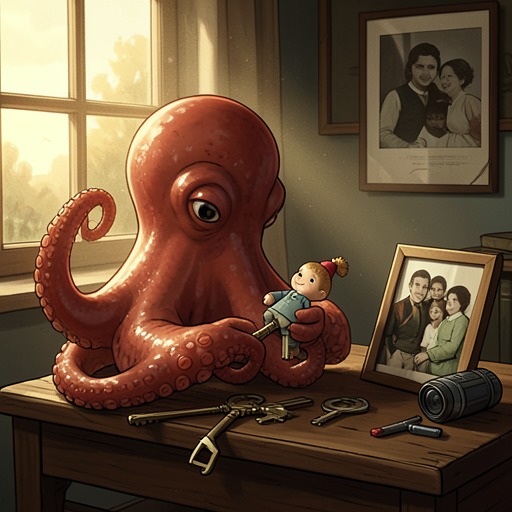
Marcellus deliberately takes the license from Terry’s desk. He recognizes it as resembling the license in his collection and notes that such a card states a person’s full name and date of birth. In this instance, the information printed on the card matters less as a biographical record than as a means of bringing Cameron’s name into Tova’s view. Marcellus carries it down the hallway and tucks it beneath the tail of the sea lion statue, choosing a place he expects Tova to inspect.
The effort is costly. Marcellus says his appetite has been poor, and by the time he reaches his destination he has begun to feel terribly weak. The return journey across the cement hallway is slow enough to make him consider whether he might die before it is over. His private reckoning sets the license against the remaining experiences he fears losing: food, movement, contact with the glass, and the objects in his collection. He judges the errand worth that risk. The card is therefore not merely displaced by accident; Marcellus makes it the purpose of a dangerous exertion.
His plan depends on a small, established feature of Tova’s work. Marcellus expects her to return, and he knows she will run her rag beneath the sea lion’s tail, a spot she alone cleans. Tova does not come that night, but Marcellus trusts that she will come and will not leave without saying goodbye. His confidence makes the hiding place part of a message addressed specifically to her: the license will be found not through a general search, but through the repetition of a cleaning habit she has made her own.
Discovery and Recognition
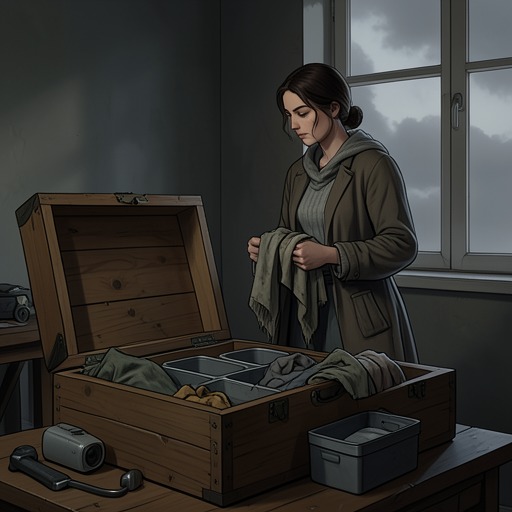
When Tova cleans beneath the statue’s tail, she finds the card in the narrow gap between the statue and the floor. Her reaction is immediate and silent: she stands holding it and studies it before asking Cameron whether it is his driver’s license. Cameron recognizes it as the license he expected to collect from his cubby, not something he had reason to find beside the statue. Its unexplained journey is visible in the scene before either of them knows what it will mean.
Tova does not simply return the card. Holding it, she asks Cameron about the mother he has no relationship with, although she already knows that he came to Sowell Bay looking for his father. Cameron answers that his mother is Daphne. Tova names Daphne Cassmore, and Cameron confirms it. Only then does she quietly connect Cameron’s mother with the girl who had been seeing Erik Sullivan. The exchange changes the card’s function once more: it has brought Cameron’s identity into a conversation that links his search for his father to Tova’s past with Erik.
The identification card is not itself proof of Cameron’s parentage, nor does the scene establish that Tova learns his mother’s name by reading the card. Rather, seeing Cameron’s name on the license gives her the occasion to ask the question that elicits Daphne’s name. The revelation arrives through dialogue, while the card serves as its physical trigger and keepsake-sized focal point. That distinction makes the object’s role precise: it enables recognition without containing the whole answer.
Narrative Significance
The license’s passage from desk to statue gives a chain of ordinary actions unusual consequence. Terry’s request, Cameron’s failed encounter with the copier, his decision to leave the card behind, Marcellus’s strenuous delivery, and Tova’s habitual cleaning all contribute to its arrival in her hands. None of these steps requires the card to possess any special power. Its importance lies in the way separate routines and choices converge around it, allowing a family connection to surface at the moment Tova and Cameron are together.
The object also joins two forms of knowledge. As identification, the license presents a name and date of birth in a compact, official format. As a plot device, it places Cameron’s name before Tova, whose memory supplies a connection the document cannot state. What the card records and what Tova remembers are distinct; the revelation depends on their meeting. Its journey from an aquarium desk to a carefully chosen hiding place turns a neglected piece of paperwork into the material occasion for Tova to recognize that Cameron’s mother is the girl from Erik’s past.